New functional fitness
quotes
general
- The most common mistake in overhead pressing is creating a backward lean or a lumbar arch that effectively turns the overhead press into an incline press. The backward lean allows the upper pecs to become active as in an incline press. However, the trade-off is a large stress to the lumbar spine.
- Athletes with shoulder or wrist issues may find the parallel-grip version more comfortable than either chin-ups or pull-ups.
- single arm double leg rotational row - I believe this relatively new exercise will soon be a staple in all functional training programs. The best part about it is the way it mimics the mechanics of direction change.
- An important principle in program design is to use numerous variations of the same type of movement. Either the specific type of vertical and horizontal pull should change every three weeks or the number of repetitions should change every three weeks; in some cases, both should change.
- Chin-ups and the variations are best cycled in the strength program to correspond with the other major exercises (hang clean, split squat, bench press). Do three sets of 8 to 10 chin-ups, three to five sets of 5, and three to five sets of 3.
- Horizontal pulling movements, or rowing movements, are extremely important and must be included and prioritized in the upper body program.
- In functional training it is important that the combination of supine and overhead pressing should not take up more than 30 minutes twice per week. 30 mins = 10sets with 10 reps and 1 min rest
- Strive for balanced pressing strength in which strength is developed at a variety of angles (incline, overhead) along with stability (by using dumbbells).
- The best approach is to combine overhead presses for strength with exercises to improve shoulder stability for injury prevention.
- Strengthening the rotator cuff muscles without strengthening the scapular stabilizers does only half the job.
- training chart:
- lower body: hip dominant (deadlift), glute dominant (squat), hamstring dominant (bridge)
- pulling: vertical (pullup), horizontal (row)
- pushing: vertical (overhead press), horizontal (pushup)
- core: anti-extension (plank), lateral anti-flexion (side plank), anti-rotational anti-diagonal (chops and lifts)
- joint training:
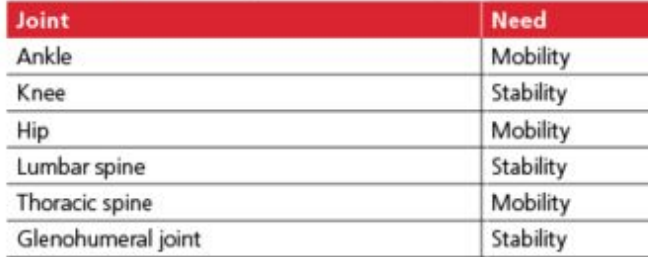
- The process is simple: Lose ankle mobility, get knee pain. Lose hip mobility, get low back pain. Lose thoracic mobility, get neck and shoulder pain (or low back pain).
- The three key muscle groups that require stability training are the
- deep abdominals,
- hip abductors and rotators, and
- scapular stabilizers.
program creation
- Train slow, get slow
- For body-weight exercise, the progression is simple. Begin with three sets of 8 repetitions in week 1, move to three sets of 10 in week 2, and finish with three sets of 12 in week 3. By the fourth week, you can generally progress to a more difficult exercise or add external loads.
- Our program is a simple periodization cycle of sets of 8 to 10 (accumulation), followed by sets of three (intensification) and then sets of five. There is nothing fancy about what we do, but we do strive to add weight or reps every week.
- Warm-ups and movement training can be divided into linear days and lateral days. Linear warm-up is used to prepare the athlete for straight-ahead speed, plyometrics, and conditioning, and lateral warm-up is used to prepare the athlete for side-to-side movement, lateral plyometrics, and lateral conditioning.
- Training program must have:
- Explosive power development—most often Olympic lifts, but plyometric work, swings, or jump squats can be substituted (see chapters 9 and 10)
- Bilateral hip-dominant exercises—generally trap-bar deadlifts (see chapter 6), but kettlebell sumo deadlifts and goblet squats may also be used
- Single-leg knee-dominant exercises—single-leg squats, split squats, and variations (see chapter 6)
- Unilateral hip-dominant exercises—straight-leg deadlifts and variations (see chapter 6)
- Core work—antiextension, antirotation, antilateral flexion (see chapter 7)
- Horizontal presses—bench presses, incline presses (see chapter 8)
- Vertical presses—dumbbell or kettlebell overhead presses (see chapter 8)
- Horizontal pulls—rows and variations (see chapter 8)
- Vertical pulls—chin-ups and variations (see chapter 8)
- A typical training day for Kayla consisted of the following:
- Foam roller
- Stretching
- Dynamic warm-up
- Power: medicine ball drills and plyometrics
- Strength: push (dumbbell bench press), pull (ring row), knee dominant (single-leg squat), and hip dominant (single-leg straight-leg deadlift)
- Core: done between sets (basic exercises such as plank, side plank, and carries)
- Conditioning: specific four-minute bouts that match the energy demands of judo, done primarily on a stationary bike to save joint stress
- training phases:
- phase 1: accumulation - 24 reps
- phase 2: strength - 15 reps
- phase 3: accumulation - 10-5-20 reps to work across different strength spectrums
- phase 4: strength or reset
- Ideally all strength training programs begin with power development via explosive exercises or Olympic lifts.
acronyms
- supinated grip - palms facing in toward the body
- pronated grip - palms facing forward
- neutral grip - palm facing side
- supine - laying face upwards
- prone - laying face downwards
- lateral - side
- menial - center
- linear - forward and backward
- diagonal - opposite corner
- eccentric portion - when muscles are lengthened
- concentric portion - when muscles are shortened
exercises
- 5.1 foam rolling Gluteus maximus and hip rotators
- 5.2 foam rolling Low back
- 5.3 foam rolling Upper back
- 5.4 foam rolling Tensor fasciae latae and gluteus medius
- 5.5 foam rolling Adductors
- 5.6 foam rolling Posterior shoulder
- 5.7 foam rolling Pecs
- 5.13 T-spine drill 2
- 5.14 T-spine drill 3
- 5.15 Ankle mobility drill 1
- 5.16 Ankle mobility drill 2
- 5.18 Hip mobility drill 2
- 5.19 Hip mobility drill 3
- 5.20 Floor slides
- 5.26 Backward straight-leg deadlift walk
- 5.31 Straight-leg skip
- 5.37 Lateral skip
- 5.38 Cross-over skip
- 5.40 Carioca
- 5.41 Lateral crawl
- 6.14 split squat
- 6.23 Cross-Reaching Single-Leg Straight-Leg Deadlift
- 6.24 Cable loaded single-leg straight-leg deadlift
- 6.26 Stability ball leg curl
- 7.13 Half-kneeling in-line stable chop
- 7.14 Half-kneeling in-line stable lift
- 7.15 Lunge-position chop
- 7.16 Standing chop
- 7.17 Standing lift
- 7.18 Standing transverse chop
- 7.19 Step-up lift
- 7.26 get-up
- 7.27 Medicine ball side throw
- 7.28 Medicine ball half-kneeling side-twist throw
- 7.30 Medicine ball front-twist throw
- 7.31 Medicine ball single-leg front-twist throw
- 7.32 Medicine ball standing overhead throw
- 7.33 Medicine ball tall kneeling chest throw
- 7.6 Stability ball rollout
- 7.7 Body saw
- 7.9 Ab wheel rollout
- 8.10 Single-arm, double-leg rotational row
- 8.19 Standing external rotation
- 8.6 Cat–cow
- 9.10 45-degree lateral bound
- 9.11 Power skip
- 9.2 Box jump
- 9.3 Single-leg box hop
- 9.4 Single-leg lateral box hop
- 9.5 Lateral bound and stick
- 9.7 Single-leg hurdle hop and stick
- 9.8 Single-leg lateral hurdle hop and stick
- 10.11 Kettlebell swing